Sizing Backup Power by Starting Amps, Not Running Watts
Almost every undersized backup power system I've ever looked at was sized the same way: somebody listed everything in the house, added up the running watts, bought a unit a little bigger than the total, and called it done. Then the first real outage came, the air conditioner tried to start, and the whole plan fell over. Running-watts math isn't wrong, exactly. It's just answering the wrong question. Your system doesn't fail on what your loads run at. It fails on what they start at.
What's Actually Happening in That First Second
An electric motor at rest is basically a dead short. In the first fraction of a second after it switches on — before it gets spinning — it draws a surge of current several times higher than what it settles down to while running. That surge is called starting current, and on the motor's nameplate it's printed as LRA: locked rotor amps. The running draw is there too, as FLA or RLA (full-load / rated-load amps).
The conversion is simple: amps × volts = watts (roughly, for sizing purposes). A motor that runs at 15 amps on a 240-volt circuit is a 3,600-watt load once it's spinning. If its nameplate says 90 LRA, that same motor demands around 21,600 watts for the moment it's trying to start. Your power source has to survive that moment — every time, including when other loads are already running — or the motor never starts, the voltage sags, breakers trip, and electronics take the hit.
The Two Loads That Decide Your Size
In a typical house, two motors tower over everything else:
Your central air compressor. The biggest motor in most homes, and it usually tries to start while everything else is already running — because it's hot, which is why the power's out in the first place.
Your well pump (if you have one). Submersible pumps start hard, and they start whenever the pressure tank calls — which is to say, whenever they feel like it, including mid-shower during the AC's startup attempt.
Behind those two: septic pumps, sump pumps, fridge and freezer compressors (small surges, but they add up), and a furnace blower. Lights, TVs, and chargers have no surge at all — resistive and electronic loads are the easy part. Motors are the whole game.
The Worked Example: A House That "Adds Up" Fine
Say your list looks like this, running watts:
Fridge: 150 W
Lights, TV, Wi-Fi, chargers: 600 W
Well pump (running): 1,000 W
3-ton central air (running): 3,500 W
Everything else you'd actually use: 950 W
Total: about 6,200 running watts. A 7,500-watt portable or a small battery system looks like it covers that with room to spare. This is exactly the math that gets people in trouble.
Now start the air conditioner. Its nameplate says 83 LRA at 240 volts. 83 × 240 = roughly 19,900 watts of momentary demand — from one appliance, for a second or so. Your 7,500-watt source can't produce it. The voltage collapses, the compressor strains and fails to start (hard on the compressor, by the way — repeated failed starts shorten its life), and if you're lucky a breaker trips before anything expensive cooks.
The well pump tells the same story smaller: running at about 1,000 watts, its start surge can run three to five times that — call it 3,000–5,000 watts for the moment it kicks on. Two motors starting in the same second is how "plenty big on paper" systems die in practice.
How People Who Do This for a Living Handle It
Size around the two biggest motors, not the total. List your loads, find the two largest starting surges, and make sure your source can carry everything already running plus the biggest surge — then check whether the second motor starting at the same moment breaks you, and plan for it if it does.
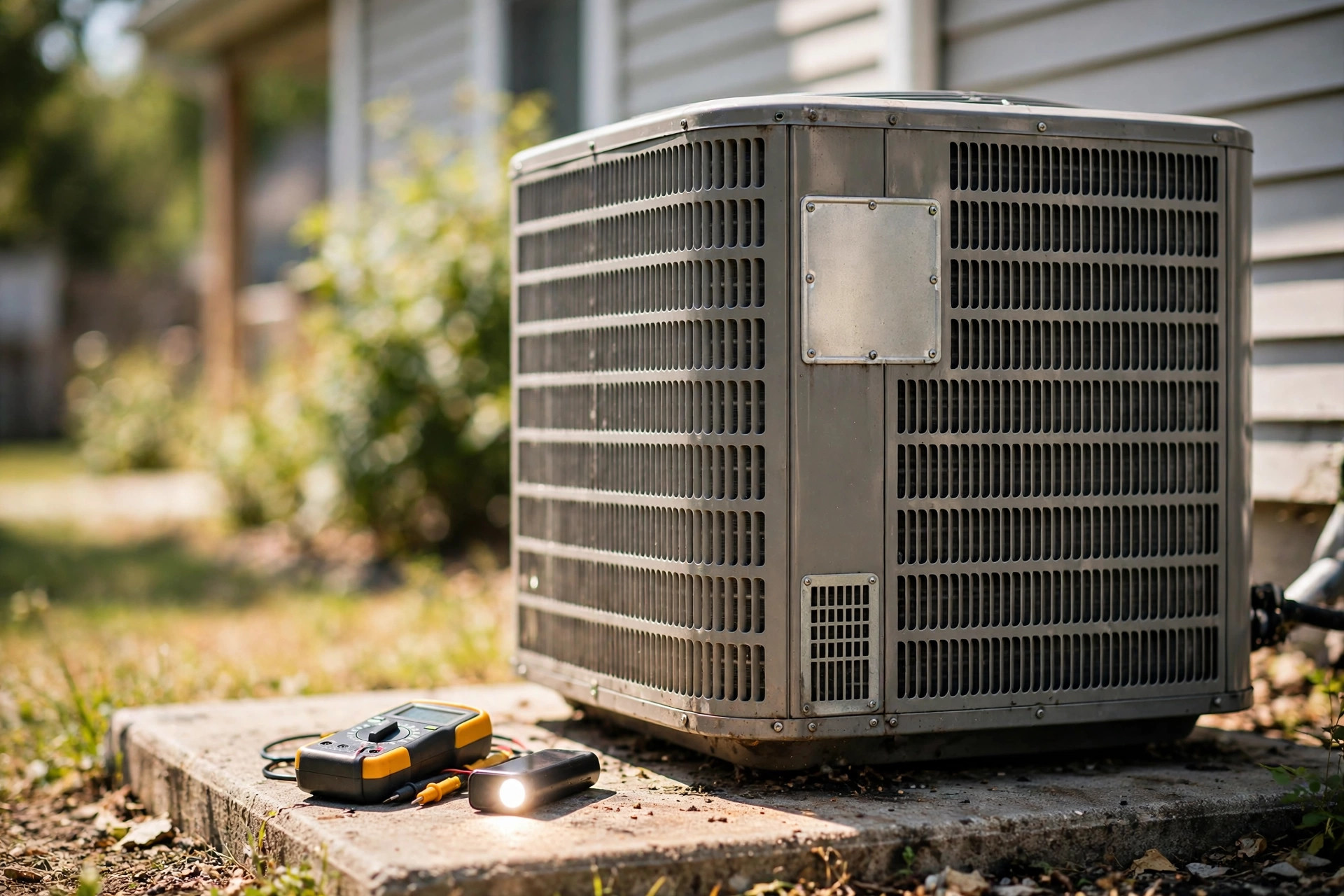
Read nameplates, not brochures. LRA is printed on your AC's outdoor unit and in your pump's specs. Five minutes with a phone flashlight beats every online calculator.
Soften the biggest surge. A soft-start kit on the air conditioner (the MicroAir EasyStart is the one most people end up with) ramps the compressor up instead of slamming it, and can cut starting draw dramatically — often by half or more. It's a few hundred dollars and it can drop a whole size class off the generator or inverter you need. On a well pump, a variable-speed or soft-start pump does the same job.
Sequence what you can. Load-management modules on standby systems shed and stagger big loads automatically. On a manual setup, the sequencing is you: don't run the dryer while the AC and pump are fighting.
Give motors their honest share of the budget. This is why a whole-home standby install lands where it does — $15,000 to the mid-$20,000s for the air-cooled class — because the unit is sized for your worst second, not your average minute.
The Rule to Take With You
Running watts tell you how long a battery lasts and how much fuel you burn. Starting amps tell you whether the system works at all. Size for the surge, then check the running math — never the other way around.
This is the single most common place quotes go wrong, and it's why the first thing I built for this site was a worksheet that starts with your motors instead of your light bulbs. If you're comparing options, the flagship comparison shows how each type of system handles surge — portables, batteries, and standby generators all have different surge ceilings, and that ceiling matters more than the headline wattage.
I'm Ben — I help homeowners across Texas, Florida, and the Carolinas size and install whole-home standby generators for a living, and I started Grid Proof Power to give the straight version of this stuff. The free sizing worksheet walks your own house through this exact math — nameplate numbers, biggest motors first: gridproofpower.com/sizing-worksheet. Already staring at a quote that was sized off running watts? Send me a DM — I'll sanity-check it for free.
