Your Backup Power Options, Honestly Compared
Everybody shopping for backup power gets shown the best version of four very different products, usually by somebody selling one of them. I sell and install whole-home standby generators for a living, so you can guess which one puts food on my table — but each of these options is the right answer for somebody and the wrong answer for somebody else. Here's how they stack up, what they really cost, and the catch nobody puts in the brochure.
Option 1: The Portable Generator
What it is: A gasoline (or dual-fuel) generator on wheels, typically 5–12 kW, that you roll out when the power dies and connect with extension cords or a manual transfer switch.
What it really costs: The spectrum is wide. A few hundred dollars for a basic unit, roughly $1,500 for a good inverter model off the shelf — but a big Cummins or Kohler portable can run $7,000–8,000 before you even add the transfer switch. A transfer switch and inlet box installed by an electrician adds several hundred more — worth it if you go this route.
Who it's for: Renters, tight budgets, and anyone whose outages are short and rare. It will keep a fridge cold, run some lights, charge phones, and power a window unit or a space heater.
The catch: It's manual everything. You have to be home, awake, and able-bodied when the outage hits, and it runs a handful of circuits, not your house. And the safety rule is absolute: carbon monoxide kills people every outage season. A portable runs outside, at least 20 feet from windows and doors — never in a garage, never on a porch "just for a minute." If you won't follow that rule in a storm at 3 a.m., this isn't your option.
Option 2: The Whole-Home Standby Generator
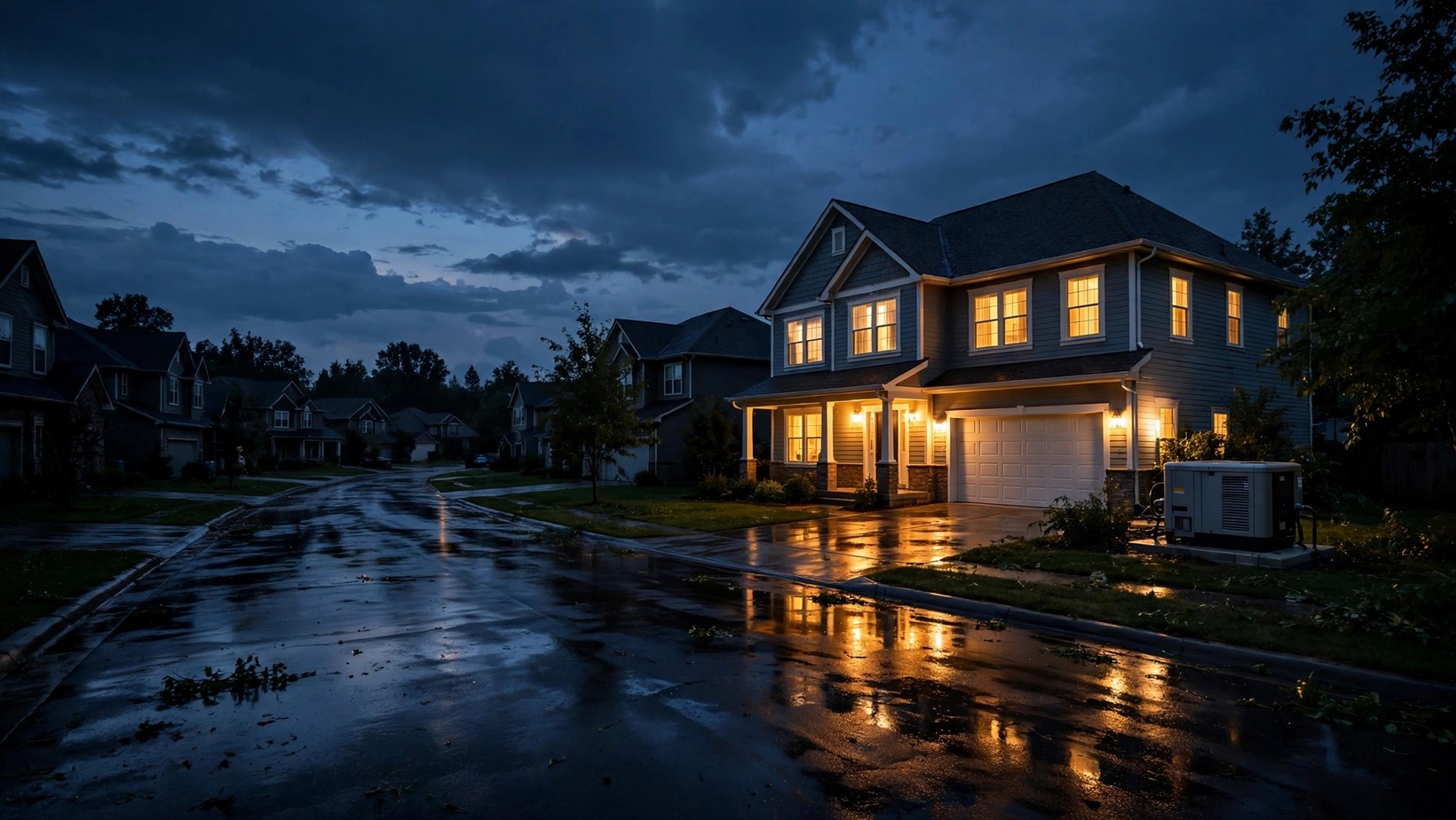
What it is: A permanently installed unit (the Generac, Kohler, and Cummins class) on a pad outside, wired to an automatic transfer switch. Power drops, it starts itself in about ten seconds, and runs the house — including central air — until the utility returns. You do nothing.
Two classes, briefly: Most homes get an air-cooled unit (roughly 10–26 kW — a fan-cooled engine, no radiator), and that's the class the prices in this article are about. Large homes and estates step up to liquid-cooled (30 kW and up — a radiator engine that runs slower, quieter for its size, and is built to run for days). The price steps up with it: a whole-home estate install can land in the $40,000s to $50,000s, and anything larger is commercial grade, into the hundreds of thousands.
What it really costs: Installed, realistically $15,000 to the mid-$20,000s for the air-cooled class, depending on unit size, gas supply, panel, and placement. Anyone who quotes a firm number without asking about your panel and gas line is guessing.
Who it's for: Anyone who wants the whole house covered through multi-day outages, anyone who's away from home a lot, and anyone with medical equipment that can't wait for somebody to roll a portable out of the garage.
The catch: It's the second-most-expensive option here, it needs a permit and inspections (permitting alone can run four to five weeks), and it runs on natural gas or propane — natural gas means no refills but you're tied to the gas utility; propane means the supply is yours, sized in days, and you're responsible for keeping the tank filled. It also needs basic maintenance, like any engine.
Option 3: The Home Battery (ESS)
What it is: A wall-mounted battery wired to a set of essential circuits. Power drops and it takes over instantly and silently — no engine, no fuel, no noise.
What it really does — read this part carefully: Most battery systems in this class are essentials-only, by design. Take the Bronco Power Boost, a Houston-built unit I've researched closely: 120 volts only, 3.0 kW of continuous output, about 3.6 kWh of storage in its base configuration. That runs your fridge, lights, Wi-Fi, garage door, and a CPAP for roughly 16 to 20 hours on light loads. It will not run your central air, electric range, or dryer — and stacking more batteries adds hours, not power. The output ceiling doesn't move. Other systems take the same essentials-only approach (up to about 20 hours on protected circuits) and add a genuinely useful trick: they can recharge directly off a standby generator, so the battery handles the quiet hours and the generator tops it back up. Larger "whole-home class" batteries exist too, but expect $13,000 and up installed — and even then, runtime is measured in hours, not days.
What it really costs: Around $5,500 for a unit like the Bronco before installation, and up from there fast as you add capacity.
Who it's for: Condo and townhome owners, strict HOAs, and zero-lot-line homes where a standby generator is flat-out prohibited — no pad, no exhaust, no gas line, no problem. Also anyone whose real need is keeping the fridge, the internet, and a CPAP alive quietly overnight.
The catch: A battery doesn't make power; it stores it. When it's empty, it's empty until the grid (or a generator, or solar) refills it. And one warning I give everybody: if a salesperson quotes you a 30% federal tax credit on a battery, that credit — Section 25D — ended December 31, 2025. Plenty of websites still advertise it. For a 2026 purchase, it's gone.
Option 4: Solar + Storage
What it is: Rooftop solar panels paired with a battery. The panels generate, the battery stores, and in an outage the combination runs your essentials — refilling itself every sunny day.
What it really costs: The most of anything on this list. Panels plus storage commonly land in the $25,000–$45,000+ range depending on system size, roof, and market.
Who it's for: Homeowners who want solar anyway for the bill offset, with backup as the second job. In a multi-day outage with decent sun, it's the only option here that can go the distance on essentials.
The catch: Solar alone does nothing in an outage — without a battery and the right inverter setup, your panels shut off with the grid (that's a safety rule, not a defect). Output depends on roof direction, shade, weather, and season; a cloudy December week is not a June week. Add HOA approvals and your utility's net-metering rules to the homework list.
The Part Everybody Gets Wrong: Sizing
People size backup power by adding up running watts. Plans actually break on starting amps — the surge a motor draws in its first second. Your central air compressor and your well pump are the usual killers: a unit that looks fine on paper can't start them. Before you buy anything, list what must run at the same time, find the two biggest motor loads on it, and size around their startup surge — not their running draw.
The Fifth Answer: Stack Them
Every so often I talk to somebody who doesn't want any one of these — they want the whole house, off the grid, no utility required. That answer exists, but it's not a product. It's a system: solar to generate, a battery to store, and a standby generator as the backstop. The panels carry the house on sunny days, the battery carries it through the night, and when a cloudy stretch drains the battery down, the generator tops it back up and goes quiet again.
The honest catches: it's the most expensive route on this page by a wide margin, your fuel tank becomes your power plant (sized in weeks, and keeping it filled is your job), and the whole thing has to be sized for your worst week of weather, not your average day. Most people who say "off-grid" actually want "grid-optional" — still connected, but able to run indefinitely when the grid drops. That's the same stack, without the pressure of never needing the utility again. Either way, this one gets designed around your loads, not picked off a shelf.
One more case: the homestead with no grid to connect to in the first place. Good news — no grid means no utility approval process at all; that whole layer of paperwork disappears. What's left depends on the county. In much of rural Texas, an off-grid system on unincorporated land needs no building permit for the array itself (the permits that still bite are the septic system and the well). Stricter states go the other way — some counties require days of battery autonomy and a standby generator on an automatic switch as part of the approved design. Either way, check the deed restrictions on your land and your insurer's requirements before you assume the county is the only voice in the room.
Questions to Ask Any Installer (Including Me)
Is the quote turn-key — does the price cover everything from the unit to the permits, or will there be surprise costs later?
Who pulls the permits, and what's the realistic timeline in my county?
Is a panel upgrade included, or is that a surprise later?
What's the maintenance plan, what does it cost after year one, and does it auto-renew?
What's covered under warranty — parts, labor, how many years — and who do I call at 2 a.m.?
If an installer can't answer those five cleanly, keep shopping.
Which One Is Probably You?
Short outages, tight budget, you're home to deal with it: portable — with the carbon-monoxide rules treated like gospel.
Multi-day outages, whole house, medical devices, or you're gone a lot: standby generator — the only set-and-forget option that runs everything for days.
Condo, HOA, or no place a generator is allowed to go: battery ESS, sized honestly around essentials.
You want solar anyway and backup is the bonus: solar + storage, with your eyes open about cloudy weeks.
You want the whole house covered with the grid as a backup, not the other way around: the stack — solar, battery, and a standby generator working as one system.
There's no universally "best" system here — only the one that matches your house, your budget, and the outage you're actually likely to get.
I'm Ben — I help homeowners across Texas, Florida, and the Carolinas size and install whole-home standby generators for a living, and I started Grid Proof Power to give the straight version of this stuff. Follow the page: next up is a free sizing worksheet that walks
through the starting-amps math for your own house. Already staring at a quote? Send me a DM — I'll sanity-check your sizing for free.
Get the free sizing worksheet: Download the free sizing worksheet
