Off-Grid vs Grid-Optional vs Backup Power — What's the Difference, Really?
People use these three phrases like they're interchangeable, usually in the same sentence: "I want to go off-grid so I have backup power." They're not interchangeable. They're three different setups, at three different price points, with three very different answers to one question: what happens when something goes wrong? Getting the words right matters, because the words decide what you build — and what it costs.
Backup Power: The Grid Is the Plan, This Covers the Gap
What it is: The utility is your power company, full stop. A backup system exists for one job — carry the house (or the important parts of it) from the moment the grid drops until the moment it comes back.
What it looks like: Any of the single options. A portable generator you roll out and plug in (roughly $1,500 for a good inverter model, up to $7,000–$8,000 for the big portables). A home battery that silently covers your essentials (around $5,500 for the unit before installation). Or a whole-home standby generator that starts itself in about ten seconds and runs everything, central air included — installed, realistically $15,000 to the mid-$20,000s for the standard air-cooled class, and into the $40,000s–$50,000s for the liquid-cooled estate class.
The pressure level: low. If your backup runs out of fuel or the battery drains, the outage is uncomfortable — but the grid is coming back, and everybody knows it. You're bridging a gap, not replacing a utility. I compared all four backup options head-to-head in my honest comparison of backup power options if you want the full version.
Grid-Optional: The Grid Is Your Backup
What it is: Your house makes and stores its own power and can run indefinitely without the utility — but the utility is still connected, still there, still an option. Most people who tell me they want to "go off-grid" actually want this. They don't want to leave the grid. They want the grid to stop mattering.
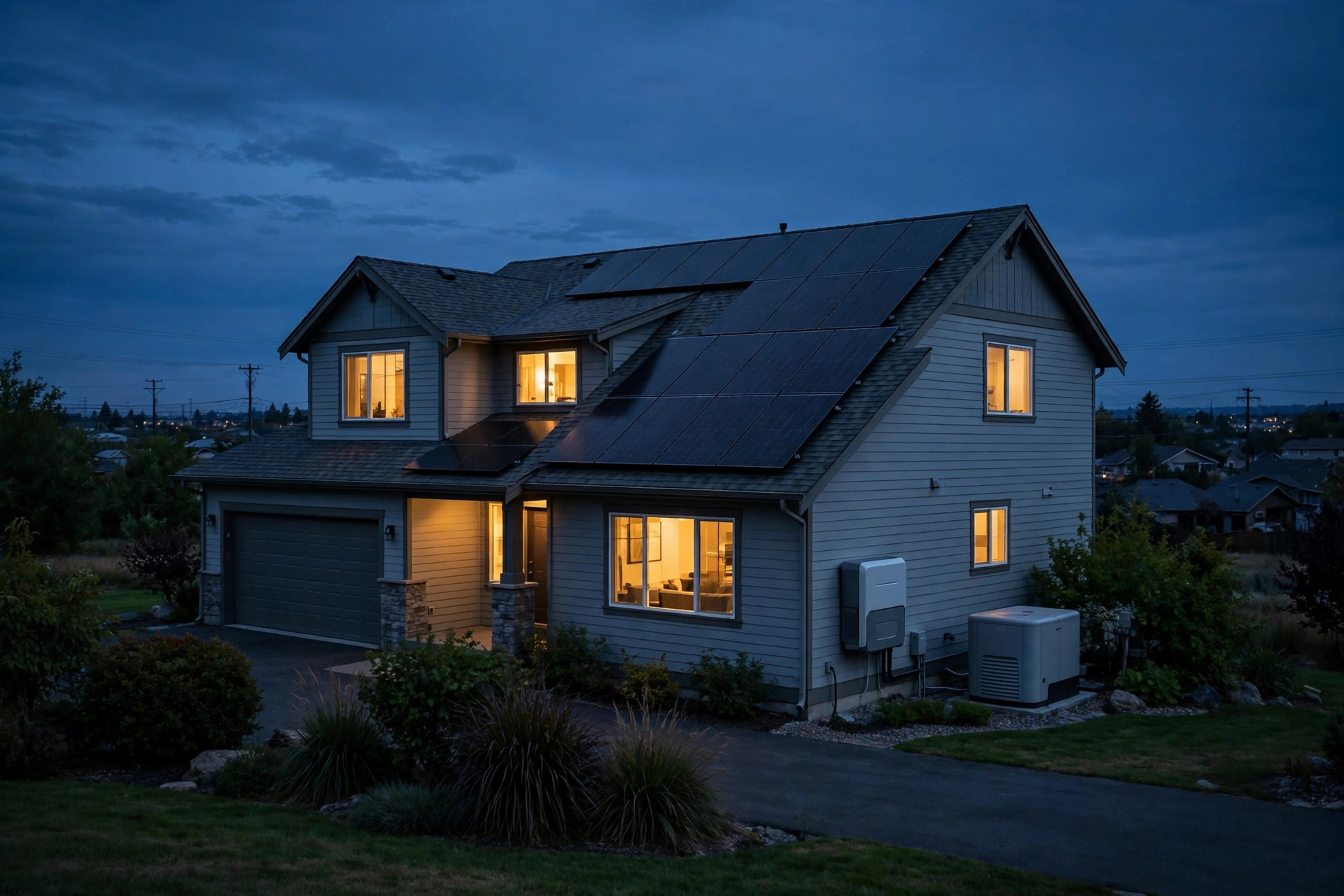
What it looks like: Not a product — a system. Solar panels to generate, a battery to store, and a standby generator as the backstop. The panels carry the house on sunny days, the battery carries it through the night, and when a cloudy stretch drains the battery down, the generator tops it back up and goes quiet again. Panels plus storage alone commonly land in the $25,000–$45,000+ range, and adding the generator backstop takes it up from there.
The pressure level: medium. Here's the thing nobody says out loud: if a grid-optional system has a bad week — terrible weather, a component down, a fuel delivery missed — the consequence is a utility bill. You lean on the grid for a few days and fix the problem at your own pace. The grid is your safety net, and having a safety net changes every design decision. You can size for your typical bad stretch instead of your worst imaginable one.
Off-Grid: There Is No Safety Net
What it is: No utility connection at all. No meter, no service line, no fallback. Everything the house uses, the house makes or stores.
What it looks like: The exact same stack as grid-optional — solar, battery, generator backstop. That's the part that surprises people. The equipment is the same. The pressure isn't.
The pressure level: total. An off-grid system has to be designed for your worst week, not your average one: the cloudy December stretch, the house full of guests, the well pump working overtime. Your battery bank needs days of autonomy, not hours. Your fuel tank becomes your power plant, sized in weeks, and keeping it filled is your job. If the system fails at 2 a.m. in a freeze, there is no utility truck coming and no grid to lean on while you troubleshoot — there's you, a flashlight, and whatever margin you built in. That margin is what off-grid actually costs. The generator isn't bigger. The consequences are.
One genuine upside: no grid means no utility approval process. That whole layer of paperwork — interconnection applications, net-metering rules — simply disappears. What's left is the county layer (permits, septic, well), your deed restrictions, and your insurer, and those depend on where you live.
The Two Questions That Tell You Which One You Are
Skip the labels and answer these honestly:
On day four of bad weather, what's your plan? If the answer is "the power company," you're shopping backup or grid-optional. If the answer is "me," you're off-grid — size like it.
If the system quits at 2 a.m., who fixes it and how fast do they have to be? Backup: whenever the grid's back. Grid-optional: this week is fine. Off-grid: you, tonight.
Most suburban and small-town homeowners land on backup or grid-optional, and there's no shame in either — they're the rational answers for a house that has a grid connection available. True off-grid is mostly a rural answer: land without a service line, or a place where bringing power in costs more than making your own.
Which One Is Probably You?
You want the lights, fridge, and air covered when the grid drops, and that's the whole job: backup power. Pick your option, size it honestly, done.
You want the house to run itself — sun, storage, generator backstop — with the grid as a safety net you rarely touch: grid-optional. Same independence, a fraction of the pressure.
There's no grid to connect to, or you've decided there won't be: off-grid. Budget for the worst week, size the fuel in weeks, and build in margin like your comfort depends on it — because it does.
If you want the full map of how these systems are built and what connects to what, the Off-Grid Power hub walks through every piece. Start with the words, though. The most expensive mistake in this whole business is building an off-grid system when you wanted grid-optional — or worse, building a backup system and believing it's off-grid.
I'm Ben — I help homeowners across Texas, Florida, and the Carolinas size and install whole-home standby generators for a living, and I started Grid Proof Power to give the straight version of this stuff. Whichever of the three you're building, it starts with your loads: grab the free sizing worksheet at gridproofpower.com/sizing-worksheet and run your own house through it. Already staring at a quote? Send me a DM — I'll sanity-check your sizing for free.
